The Sacred Hair Wreaths of Mormon Pioneers
When we think of Victorian hair wreaths, we often envision them as the product of middle-class women who had ample leisure time to commit to their fancy work projects, created for display in the cluttered splendor of their refined parlors. However, this narrow view of the Victorian hair wreath ignores their multifaceted history, their dynamic meanings, the diverse environments they inhabited, and, often, the women who created them. Pioneer women across the American frontier also made hair wreaths as they carried domestic traditions into new territories, and the typical image of a velvet-draped parlor gives way to the reality of the unpretentious homes of pioneers at a time when much of the country was still a wilderness. Furthermore, 19th century hair wreaths were also created to be displayed in sacred religious spaces, which came to be particularly significant within Mormon pioneer culture. For Mormon pioneer communities, hair wreaths represented a range of meanings, from simple sentimentality to sophisticated expressions of collective identity, ecclesiastical hierarchy, and beliefs regarding the physical nature of the soul and its eternal restoration.
Instructions for the most basic traditional technique used to create wirework hair flowers perhaps finds its earliest written documentation not in a mass-produced manual, but in an 1851 journal entry by pioneer Emily B. Spencer. This precedes the earliest published American instructions I have encountered so far in my research by nearly a decade - most notably Levina Buoncuore Urbino’s "Hair Work" chapter in the 1859 edition of Art Recreations. While Urbino’s work eventually provided a formal print foundation for the craft, Spencer’s private record captures these specific wirework techniques in practice well before they surfaced in the popular press. For Spencer and her contemporaries, mastering such a meticulous craft in a wilderness setting was not just a way to pass time; it was a physical manifestation of the biblical call from Isaiah 35:1 to “make the desert blossom as a rose.” By choosing to manifest beauty through such delicate and demanding work, Mormon pioneer women transformed the harsh reality of their environment into a space of domestic and spiritual significance.
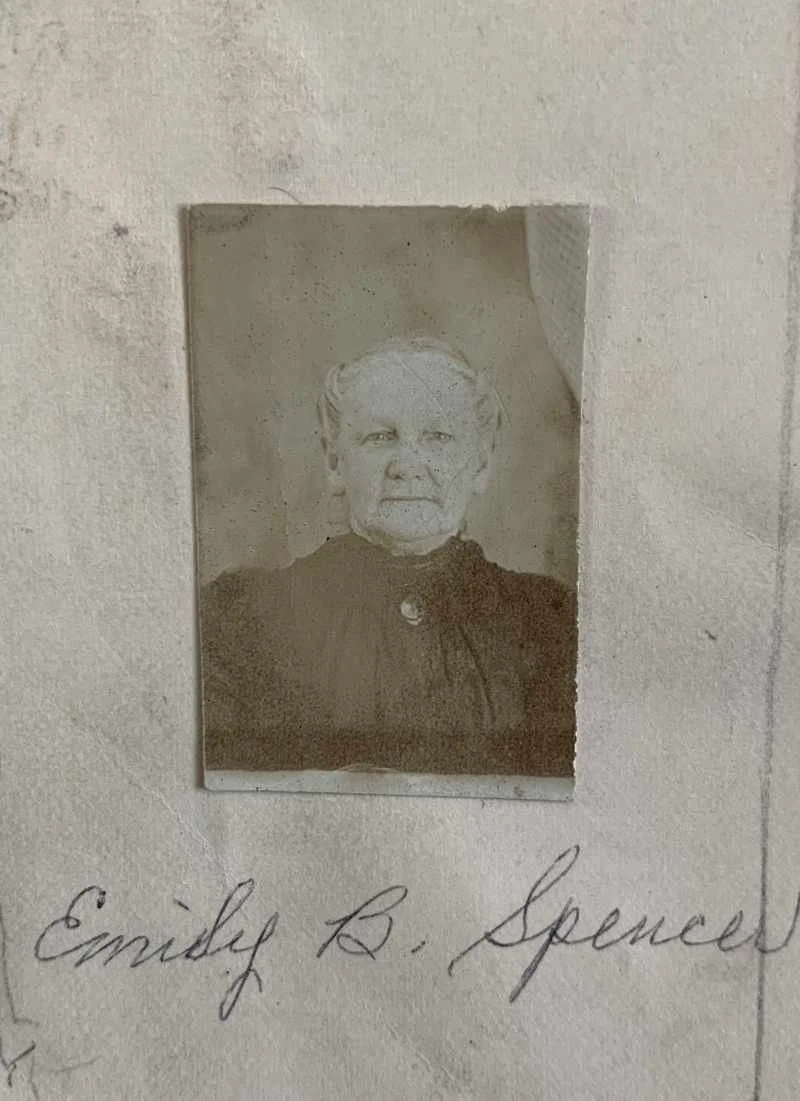
Portrait of Emily B. Spencer, Mormon pioneer of the American frontier.
Spencer describes how to achieve the traditional basic gimp technique, saying, “Take a piece of wire 20 inches long and double it, then take a fine bunch of long hair. Wrap the hair once over a knitting needle and hold the hair tight against the needle with the thumb and forefinger. Slip the wire under the needle so as to cross the hair, both the short and the long end. Bring the end of the the wire on top of the other, then across the other end under, forming a tight twist to prevent the hair from slipping. Now wrap the long end of the hair over the needle and proceed as before until all the hair is used and all the wire except enough for the stem. When finished twist the two ends of the wire together.” To create flower buds with shorter hair, she explains, “double the two ends together and wrap with silk or zephyr to hold in place.”
Beyond simply outlining the techniques involved in creating hair flowers, Spencer further elaborates on how to embellish them with coiled wire and beads, as well as how to create what she refers to as “spangles” - long, coiled sections of gimped hair. “For spangles," she says, “wrap woven hair around and around the needle. Push up tightly together and slip off, then straighten out as desired. Work these into the wreath short or long.” Many spangles can be observed in the Manti Temple hair wreath pictured below.
While some Victorian era family hair wreaths were assembled to depict branching trees, the woven composition of Mormon wreaths frequently depicted the complex, intertwining relationships of their polygamous families. These wreaths functioned as a material collective memory, a tangible representation of the organic nature of sister-wives and their children through the interlocking of their varied locks.
The Manti Temple hair wreath offers a striking example of this symbolism of collectiveness. Unlike many hair wreaths where specific flowers are attributed to specific individuals, the Manti wreath features a tight collection of flowers woven from an anonymous mixture of hair from fellow sisters of the local Relief Society. This created a visual sense of a "sisterhood without rank," where the emphasis was placed on the strength of their unified identity rather than on individual distinction. In this light, the wreath stands as a testament to the women’s shared labor and their active role in weaving the social and spiritual fabric of their community.
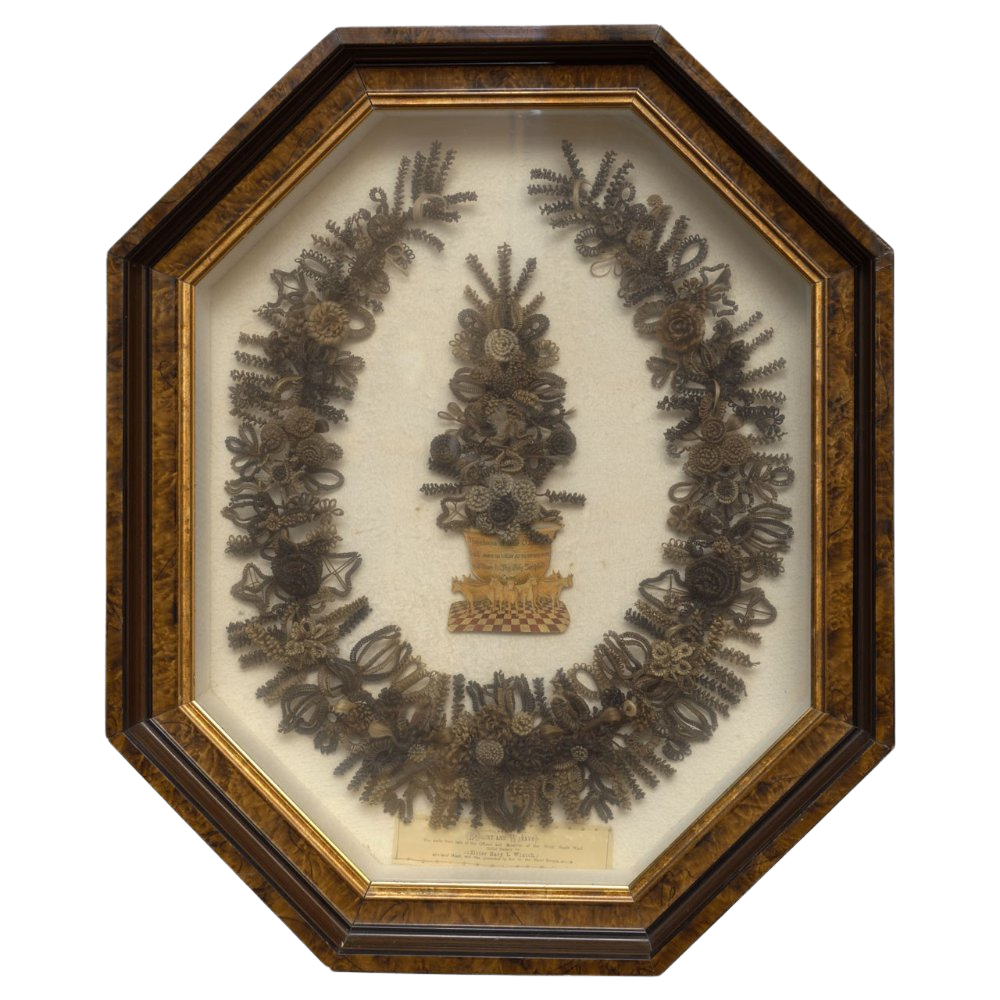
Manti Relief Society Hair Wreath, c. 1855
Though some hair wreaths created by Mormon pioneer women functioned as mourning objects, hair art was also embedded with specific theological meanings regarding the resurrection. The use of hair from living people within the congregation to create wreaths symbolized a hope for life beyond mortality. This reflected their belief that in the resurrection “even a hair of the head shall not be lost; but all things shall be restored to their proper and perfect frame” (Alma 40:23). By preserving hair, they were preserving a physical piece of the soul’s eternal journey.
Far from being just a passive domestic pastime, the creation of hair wreaths provided Mormon pioneer women with a tangible form of ecclesiastical agency. Through the intentional beautification of their modest homes and sacred spaces, they moved beyond simple decor to become visual archivists of their communities, translating abstract Mormon doctrines into a permanent material record. Furthermore, in stark contrast to the vast majority of extant 19th-century hair wreaths that remain frustratingly anonymous, Church historians have taken deliberate care to document the makers and provenance of many of the hair wreaths in their collections of historical artifacts, treating these objects as a foundation for their collective identity that anchored women's labor to the official history of the Church.
Reducing Victorian hair wreaths to a mere 'parlor art' for middle class women ignores the sophisticated role they played in the lives of the many women who created them. For Mormon pioneer women, these wreaths were not solely static decorations created simply to pass the time; they were a resilient medium often used to navigate the upheaval of the American frontier, document intricate family bonds, and anchor a shared spiritual future in a new and promising landscape.
© 2025 Diane Irby. This content may not be copied or distributed without written permission from the author. If you would like to share about this archival discovery and the analytical insights in this essay in your own work, writing, or social media posts, please attribute properly.
To cite this essay:
Irby, Diane. “The Sacred Hair Wreaths of Mormon Pioneers.” Victorian Hairwork by Diane Irby (victorianhairwork.art), April 4, 2026. https://www.victorianhairwork.art/journal-research/the-sacred-hair-wreaths-of-mormon-pioneers.
I do not own the copyright to all of the photos or images used in my educational materials. My use of potentially copyrighted content falls under Fair Use guidelines for the purpose of education, as outlined in Section 107 of the Copyright Act. Additionally, I have curated and annotated these collections of images in order to provide and present my own research-led analysis and scholarly synthesis, which is protected under copyright law as my intellectual property.
Bibliography
Manti Relief Society. Hair Wreath. c. 1855. Hair, wire, and wood, 35 x 29.25 x 6.5 in. Intellectual Reserve, Inc. Courtesy of the Book of Mormon Art Catalog. https://bookofmormonartcatalog.org/r_h_scripture/hair-wreath/.
Portrait of Emily B. Spencer. Photograph. n.d. FamilySearch, ID KWJ2-3X1. https://www.familysearch.org/tree/person/details/KWJ2-3X1.
Reeder, Jennifer. “‘To Do Something Extraordinary’: Mormon Women and the Creation of a Usable Past.” PhD diss., George Mason University, 2013.
Spencer, Emily B. “Hair Wreaths.” 1851. In Our Pioneer Heritage, compiled by Kate B. Carter, 2:231–32. Salt Lake City: International Society, Daughters of Utah Pioneers, 1959.